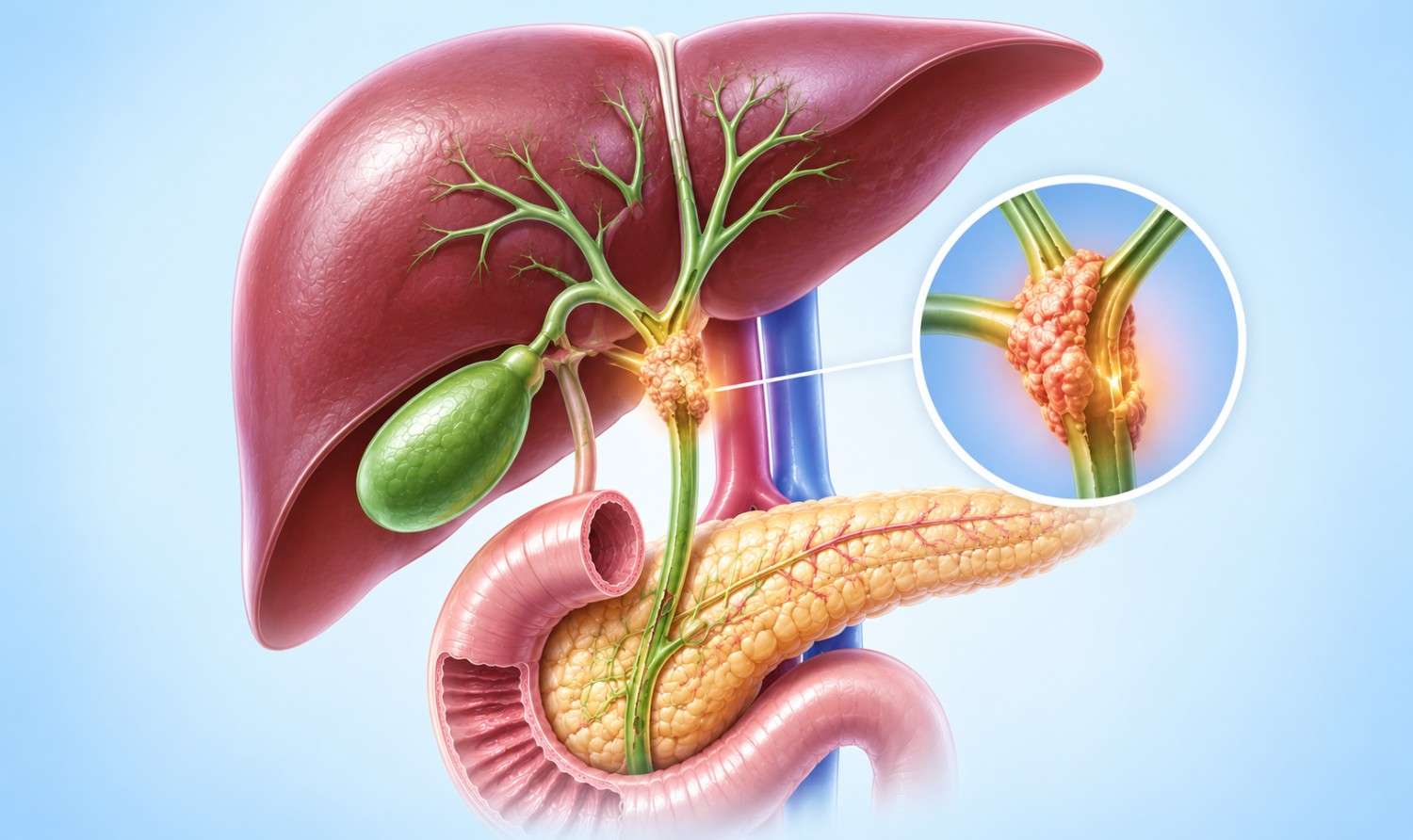
Bile Duct Cancer Treatment in West Delhi
Dr. Manish Jain is a Surgical Gastroenterologist and GI & HPB Oncosurgeon consulting in Moti Nagar, West Delhi, and affiliated with BLK-Max Super Speciality Hospital, New Delhi.
If you or a family member have been diagnosed with, or are being investigated for, bile duct cancer (cholangiocarcinoma), specialist evaluation can help clarify the diagnosis, the type and location of the tumour, and the treatment options genuinely suited to the individual case.
What Is Bile Duct Cancer?
The bile ducts are a network of thin tubes that carry bile — a fluid made by the liver that helps digest fat — from the liver and gallbladder into the small intestine. Bile duct cancer, medically known as cholangiocarcinoma, develops when cells lining these ducts grow abnormally.
Bile duct cancer is not a single, uniform disease. Where the tumour arises within the biliary system — inside the liver, near where the ducts join, or in the section outside the liver — affects how it is diagnosed, staged, and treated. Because of this, accurate imaging, staging, and specialist evaluation are essential before any treatment decisions are made.
Symptoms of Bile Duct Cancer
Bile duct cancer can cause a range of symptoms, most commonly related to blocked bile flow. Symptoms may vary depending on the location and extent of the tumour.
Jaundice: Yellowing of the skin or eyes
Dark-Coloured Urine: Urine may become noticeably darker
Pale or Clay-Coloured Stools: Changes in stool colour may occur when bile flow is obstructed
Persistent Itching: Ongoing itching can occur in association with bile flow obstruction
Abdominal Discomfort or Pain: Some patients may experience discomfort or pain in the abdomen
Loss of Appetite: Reduced interest in food may occur
Unexplained Weight Loss: Unintentional weight loss can be a possible symptom
Fatigue: Persistent tiredness or reduced energy
Fever: Fever may occur in some cases
These symptoms can also occur with conditions other than bile duct cancer. Persistent or unexplained symptoms should be evaluated by a qualified healthcare professional for appropriate diagnosis and treatment planning.
Types of Bile Duct Cancer
Intrahepatic Cholangiocarcinoma
Develops in the smaller bile ducts located within the liver itself. It is sometimes evaluated and discussed alongside primary liver cancers because of its location.
Perihilar Cholangiocarcinoma
Develops at the hilum — the point where the right and left hepatic ducts join just outside the liver. This is the most common site for bile duct cancer and often involves careful surgical planning due to its proximity to major blood vessels.
Extrahepatic (Distal) Cholangiocarcinoma
Develops in the section of the bile duct outside the liver, closer to the pancreas and small intestine. Its treatment planning often overlaps with that of pancreatic and periampullary tumours.
Medical Assessment Note: Bile duct cancer can differ significantly depending on where the tumour develops within the biliary system. The tumour's location, stage, involvement of nearby structures, and the patient's overall health all influence diagnosis, treatment planning, and suitability for surgery.
Risk Factors, Surgery &
Bile Duct Cancer Treatment
Bile duct cancer can vary considerably depending on its location, extent, and stage. Specialist evaluation helps determine whether surgery is appropriate and which treatment approach may be suitable for each patient.
Risk Factors and Causes of Bile Duct Cancer
In most cases, the exact cause of bile duct cancer is not known. Certain conditions are associated with a higher risk, including chronic inflammatory conditions of the bile ducts, primary sclerosing cholangitis, certain congenital abnormalities such as choledochal cysts, and some chronic liver and biliary conditions.
Certain parasitic biliary infections and long-standing biliary stone disease may also be associated with increased risk in some regions. Having one or more of these risk factors does not mean a person will develop bile duct cancer.
What Is Bile Duct Cancer Surgery?
Surgery aims to remove the cancer and, in some cases, the surrounding tissue, bile ducts, or part of an adjoining organ, with the goal of clearing the disease.
Whether surgery is possible — and what form it takes — depends heavily on where the tumour is located, its size and stage, and whether it can be safely and completely removed.
Bile duct cancer surgery can be technically complex because the bile ducts are located close to the liver, major blood vessels, and the pancreas. Detailed imaging and staging are therefore important before surgery is considered.
When May Surgery Be Recommended for Bile Duct Cancer?
Treatment planning, including whether surgery is an option, may depend on the tumour's location within the biliary system, tumour size and extent, overall cancer stage, and whether the tumour can be completely removed.
Doctors may also consider involvement of nearby structures or blood vessels, the degree of liver involvement, nearby lymph node involvement, whether the cancer has spread beyond the bile ducts, and the patient's overall health and fitness for surgery.
Types of Surgery for Bile Duct Cancer
Depending on tumour location and stage, surgical management may include bile duct resection, involving removal of the affected segment followed by reconstruction to restore bile flow into the intestine.
For tumours involving or close to the liver, a liver resection may be required alongside bile duct removal. Perihilar cholangiocarcinoma may require a combined approach involving bile duct resection and, in some cases, liver resection.
Pancreaticoduodenectomy (Whipple Procedure)
For selected cancers of the lower or distal bile duct, surgery may involve a pancreaticoduodenectomy (Whipple procedure). This is a complex operation that is also used for selected pancreatic and periampullary cancers.
Whether a Whipple procedure is appropriate depends on the tumour's exact location, stage, relationship with nearby structures, and the patient's overall health.
Lymph Node Assessment and Dissection
Assessment or removal of nearby lymph nodes may form part of bile duct cancer surgery. Examination of these lymph nodes can help with accurate cancer staging and may form part of the overall cancer-clearing procedure.
Minimally Invasive and Robotic-Assisted Surgery
Dr. Jain is a certified robotic surgeon and proctor for the da Vinci robotic platform, with a background in minimally invasive GI and HPB surgical techniques.
Whether a minimally invasive or robotic-assisted approach is suitable for a particular bile duct cancer case depends on the tumour location, complexity, and individual patient factors. The appropriate approach is decided after detailed specialist evaluation.
This section provides general educational information and is not a substitute for individualised medical advice. Only specialist evaluation of the specific case can determine the appropriate treatment and surgical approach.
When Is the Whipple Procedure Used for Bile Duct Cancer?
The Whipple procedure (pancreaticoduodenectomy) is a major operation in which the head of the pancreas, part of the small intestine, the gallbladder, and the lower bile duct are removed, followed by reconstruction to restore digestive continuity. It may be considered for selected cancers of the distal (lower) bile duct, where the tumour is close to the pancreas.
Not every bile duct cancer requires a Whipple procedure. Its suitability depends on the exact location and extent of the tumour, established through imaging and staging. The decision is assessed on an individual basis by the surgical team.
Diagnosis and Staging of Bile Duct Cancer
Depending on the case, doctors may recommend a combination of investigations to diagnose and stage bile duct cancer. These may include:
Blood tests, including liver function tests, abdominal ultrasound, CT scan, MRI, MRCP (magnetic resonance cholangiopancreatography), endoscopic ultrasound, ERCP in selected cases, biopsy or tissue sampling where appropriate, and additional staging investigations as needed.
Not every patient requires every test. The combination used depends on the individual clinical picture and is decided by the treating specialist. Accurate diagnosis and staging are important because they directly influence which surgical or non-surgical treatment options may be appropriate.
What Is ERCP and When May It Be Used?
ERCP (endoscopic retrograde cholangiopancreatography) is an endoscopic procedure used to examine and, in some cases, treat problems involving the bile ducts and pancreatic duct.
In bile duct cancer, ERCP may be used in selected patients to help visualise the bile duct, obtain tissue samples, or relieve a blockage. ERCP is a diagnostic and supportive procedure and is not, by itself, a treatment for cancer.
Not every patient with bile duct cancer requires ERCP. Its use depends on the individual clinical situation and the assessment of the treating specialist.
Bile Duct Blockage and Jaundice in Bile Duct Cancer
A bile duct tumour can partly or fully block the flow of bile into the intestine. When this happens, bile can build up in the bloodstream, potentially causing jaundice, dark urine, pale stools, and itching. Bile duct obstruction generally requires prompt medical evaluation.
In selected situations, doctors may use procedures such as biliary drainage, including placement of a stent, to relieve the blockage. This may be considered during treatment planning before surgery or as supportive care. The need for drainage and the appropriate method depend on the individual case.
How Other Treatments May Fit Into Bile Duct Cancer Care
Bile duct cancer treatment can involve more than surgery. Depending on the individual diagnosis and stage, treatment planning may include:
Surgery where appropriate, chemotherapy, radiation therapy in selected cases, targeted therapy in selected cases, immunotherapy in selected cases, and biliary drainage or other supportive procedures where appropriate.
Some patients may receive treatment before surgery, after surgery, or both, depending on staging and the overall treatment plan. Not every patient requires every one of these treatments.
Why Multidisciplinary Care Can Matter in Bile Duct Cancer
Bile duct cancer care often benefits from input across specialties. This can include an HPB/GI oncosurgeon, medical oncologist, radiation oncologist, gastroenterologist, radiologist, and pathologist, working together to review imaging, staging, and treatment options.
Coordinated evaluation can help ensure that treatment planning takes the patient's complete clinical picture into account.
Surgical Approaches for Bile Duct Cancer
Depending on the case, bile duct cancer surgery may be performed as open surgery or, where suitable, through minimally invasive or robotic-assisted techniques.
Dr. Manish Jain is a certified robotic surgeon and proctor for the da Vinci platform, with a background in minimally invasive GI and HPB surgical techniques.
Whether a minimally invasive or robotic-assisted approach is suitable depends on the tumour's location, complexity, cancer stage, and individual patient factors. The final approach is decided after detailed evaluation.
No single surgical approach is universally suitable for every patient, and no specific outcome, recovery time, or safety advantage can be guaranteed in advance.
Recovery After Bile Duct Cancer Surgery
Recovery is generally supported through:
A period of hospital monitoring after surgery, nutrition support during early recovery, gradual supervised return to normal activities, monitoring of liver and bile duct function where relevant, follow-up appointments to review healing and pathology results, and consideration of further treatment where pathology findings support it.
Recovery time varies from patient to patient depending on the type and extent of surgery, overall health, and whether additional treatment is required. No fixed recovery timeline can be promised.
Risks and Considerations of Bile Duct Cancer Surgery
As with any major surgery, bile duct cancer procedures carry potential risks. Depending on the specific operation, these may include bleeding, infection, blood clots, anaesthesia-related complications, bile leakage, other biliary complications, liver-related complications, changes in digestion, delayed recovery, and other procedure-specific complications.
The surgeon will discuss the potential benefits, risks, and alternatives based on the individual patient's condition.
Bile Duct Cancer Treatment in West Delhi
For patients in and around West Delhi, Dr. Manish Jain, a Surgical Gastroenterologist and GI & HPB Oncosurgeon, consults at the Gastro & HPB Surgery Center, Sree Jee Gastro & Liver Clinic, in Moti Nagar.
This provides residents of West Delhi neighbourhoods such as Rajouri Garden, Punjabi Bagh, Janakpuri, and Paschim Vihar access to specialist evaluation for bile duct cancer and cholangiocarcinoma.
For patients requiring hospital-based surgical care, Dr. Jain is affiliated as Director & Head of GI & HPB Oncosurgery and Robotic Surgery at BLK-Max Super Speciality Hospital, Rajinder Nagar, New Delhi.
Hepatopancreatobiliary and Gastrointestinal Cancer Care
Bile duct cancer sits within the broader field of hepatopancreatobiliary (HPB) and gastrointestinal oncosurgery. Dr. Jain's practice also covers evaluation and surgical management of related conditions, including:
Liver Cancer Surgery
Pancreatic Cancer Surgery
Gallbladder Cancer Surgery
Stomach Cancer Surgery
Esophagus Cancer Surgery
Colon Cancer Surgery
Rectum Cancer Surgery
Appendix Cancer Surgery
Because bile duct cancer can be closely related to conditions affecting the liver, pancreas, and gallbladder, evaluation by a surgeon with broader HPB and GI oncology experience can be valuable, particularly when the tumour's exact origin or extent is still being established.
Why Specialist Evaluation Matters in Bile Duct Cancer
Because bile duct cancer varies by location, type, and stage, specialist evaluation plays an important role in:
Reaching an accurate diagnosis, correctly staging the cancer, understanding the precise tumour location, assessing whether surgery is a realistic option, planning treatment appropriate to the individual case, explaining available options clearly, and coordinating follow-up care.
This evaluation is educational and diagnostic in nature. It is the starting point for an informed conversation about treatment options and does not promise a particular treatment or outcome.
Meet Dr. Manish Jain
Dr. Manish Jain is a Surgical Gastroenterologist, GI & HPB Oncosurgeon, and certified robotic surgeon with over two decades of experience in treating complex digestive system cancers and conditions.
He currently serves as Director & Head of GI & HPB Oncosurgery and Robotic Surgery at BLK-Max Super Speciality Hospital, New Delhi, and consults at the Gastro & HPB Surgery Center, Sree Jee Gastro & Liver Clinic, in Moti Nagar, West Delhi.
Qualifications: MBBS, MS (General Surgery), DrNB (Surgical Gastroenterology)
Certifications: Certified Robotic Surgeon and Proctor for Intuitive (da Vinci X and Xi); Certified PIPAC Surgeon
Professional Memberships: Indian Association of Surgical Oncology; International Hepato-Pancreato-Biliary Association; Association of Surgeons of India; Indian Association of Surgical Gastroenterology; Association of Minimal Access Surgeons of India
Hospital Affiliation: Director & Unit Head, GI Oncosurgery — BLK-Max Super Speciality Hospital, New Delhi (present)
Prior affiliations include Max Super Speciality Hospital, Saket; Rajiv Gandhi Cancer Institute & Research Centre; and Action Cancer Hospital & Sri Balaji Action Medical Institute.
Looking for a Bile Duct Cancer Specialist Near You?
If you are searching for a bile duct cancer specialist, cholangiocarcinoma surgeon, or GI & HPB oncosurgeon in your area, Dr. Manish Jain consults at the Moti Nagar clinic in West Delhi and is affiliated with BLK-Max Super Speciality Hospital in Rajinder Nagar, New Delhi.
You can call the clinic directly, use the online appointment page, or write to the clinic email to arrange a consultation and confirm the nearest available appointment slot.
Frequently Asked Questions
Bile duct cancer, or cholangiocarcinoma, is a cancer that develops in the cells lining the bile ducts — the tubes that carry bile from the liver and gallbladder to the small intestine.
Cholangiocarcinoma is the medical term for bile duct cancer. It can develop inside the liver (intrahepatic), near where the hepatic ducts join (perihilar), or outside the liver (extrahepatic/distal).
The three main types are intrahepatic, perihilar, and extrahepatic (distal) cholangiocarcinoma, classified according to where in the biliary system the tumour develops.
Common symptoms include jaundice, dark urine, pale stools, itching, abdominal discomfort, appetite loss, unexplained weight loss, and fatigue. These symptoms can also occur with non-cancerous conditions.
Diagnosis may involve blood tests, ultrasound, CT, MRI, MRCP, endoscopic ultrasound, ERCP in selected cases, and biopsy where appropriate. The exact combination depends on the individual case.
Surgery may be considered when imaging and staging show that the tumour can potentially be removed completely, based on its location, size, involvement of nearby structures, and the patient's overall health.
No. Suitability for surgery depends on the tumour's location, stage, extent, and the patient's overall health, and can only be determined after detailed individual evaluation.
The Whipple procedure (pancreaticoduodenectomy) removes the head of the pancreas, part of the small intestine, the gallbladder, and the lower bile duct. It may be used for selected cancers of the distal bile duct.
Yes. Chemotherapy may be part of treatment for some patients, either alongside surgery or as the primary treatment when surgery is not suitable, depending on the individual diagnosis and stage.
ERCP is an endoscopic procedure used to examine and, in selected cases, help treat problems of the bile ducts, such as obtaining tissue samples or relieving a blockage. It is not a cancer treatment on its own.
Recovery generally involves hospital monitoring, nutrition support, gradual return to activity, and follow-up appointments. The exact recovery time varies according to the patient and the type of surgery performed.
Dr. Manish Jain, GI & HPB Oncosurgeon, consults at the Gastro & HPB Surgery Center, Sree Jee Gastro & Liver Clinic, Moti Nagar, West Delhi, and is affiliated with BLK-Max Super Speciality Hospital, New Delhi.
You can call the clinic, use the online appointment page on this website, or write to the clinic email to schedule a consultation with Dr. Manish Jain.